

 عربى
عربىShort Answer: The conical screw barrel is ideal for rigid PVC processing because its tapered geometry delivers progressive, controlled compression, low shear stress, uniform melt temperature, and superior degassing — all critical for handling PVC's narrow thermal processing window and heat-sensitive chemistry.
Rigid PVC (unplasticized polyvinyl chloride, or UPVC) is one of the most widely used engineering thermoplastics in the world — from window profiles and pipes to cable trays and building panels. Yet it is also one of the most demanding materials to process. PVC begins to degrade at temperatures that are alarmingly close to its processing temperature, releasing toxic hydrogen chloride (HCl) gas and causing irreversible discoloration and property loss.
This is exactly why choosing the right extrusion or injection molding screw-and-barrel combination is not merely a matter of productivity — it is a question of product quality, equipment longevity, and processing safety. Among all available configurations, the conical screw barrel has emerged as the preferred solution for rigid PVC. In this article, we explore the technical, economic, and operational reasons in depth.
Content
- Understanding Rigid PVC: Why It Demands Special Equipment
- What Is a Conical Screw Barrel?
- 5 Core Reasons the Conical Screw Barrel Excels at Rigid PVC Processing
- Conical Screw Barrel vs. Other Configurations: A Technical Comparison
- Material and Surface Engineering of the Conical Screw Barrel
- Primary Applications of Conical Screw Barrel in Rigid PVC Processing
- Maintenance and Lifespan Considerations
- Key Design Parameters When Specifying a Conical Screw Barrel for Rigid PVC
- Frequently Asked Questions (FAQ)
- Conclusion
Understanding Rigid PVC: Why It Demands Special Equipment
Rigid PVC differs fundamentally from most thermoplastics. Its processing challenges include:
- Narrow thermal processing window: Rigid PVC is typically processed between 160°C and 200°C. Above 200°C, degradation accelerates rapidly.
- High melt viscosity: UPVC has a high and shear-sensitive viscosity, making uniform flow critical.
- Corrosive degradation products: HCl released during overheating corrodes metal surfaces aggressively.
- Gelation requirements: PVC powder must achieve proper gelation — partial fusion of primary particles — for optimum mechanical properties.
- Sensitivity to dead zones: Any stagnant material in the barrel will degrade and contaminate the entire melt stream.
These demands rule out many generic screw-barrel designs and make the conical screw barrel a purpose-engineered solution.
What Is a Conical Screw Barrel?
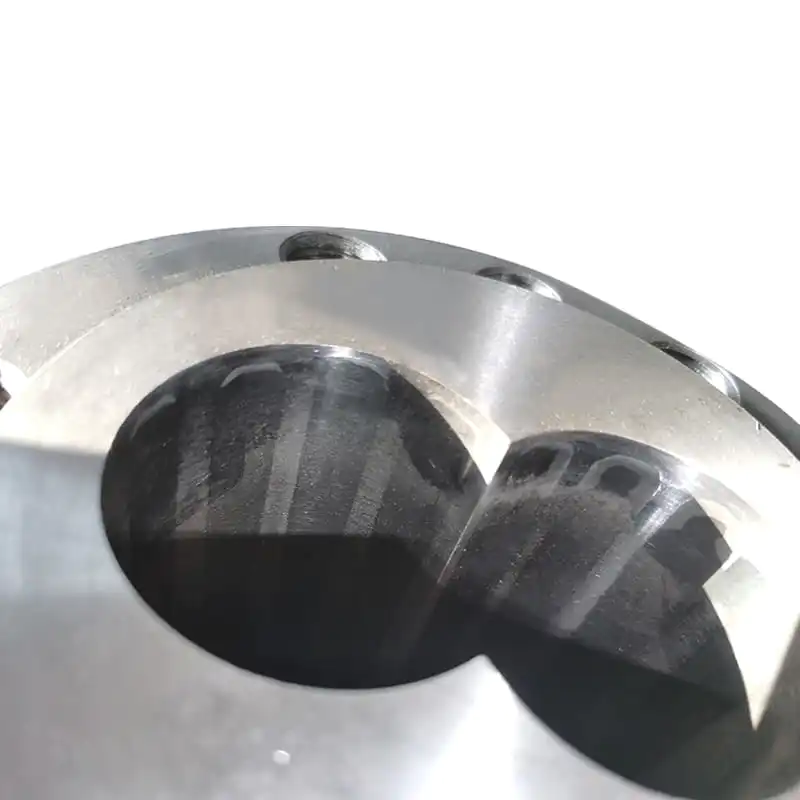
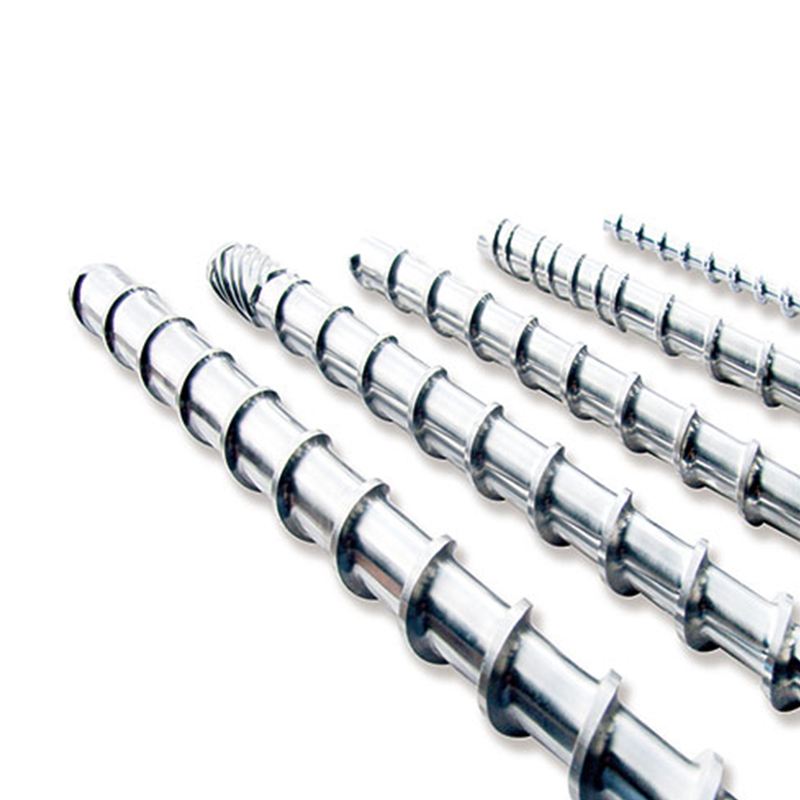
A conical screw barrel (also called a conical twin-screw barrel) features two intermeshing, counter-rotating screws that taper from a larger diameter at the feed end to a smaller diameter at the discharge end. This design is the opposite of parallel twin-screw extruders, which maintain a constant diameter throughout.
Key Geometric Features
- Tapered screw profile: Larger diameter at feed zone for efficient material intake; smaller diameter at metering zone for precise output control.
- Counter-rotating intermeshing: Screws rotate inward toward each other, creating positive material conveyance and a self-wiping action.
- Positive displacement pumping: The conical geometry acts like a pump, building pressure progressively without relying on high shear.
- Large gearbox spacing: Wider screw centers at the feed end allow for robust gearboxes capable of high torque.
5 Core Reasons the Conical Screw Barrel Excels at Rigid PVC Processing
1. Gentle, Progressive Compression Protects Heat-Sensitive PVC
The conical taper naturally creates a progressive compression ratio along the screw length. Unlike abrupt compression in single-screw designs, the gradual reduction in channel volume means the PVC compound is never subjected to sudden pressure spikes or excessive shear heat. The material is "squeezed" gently, which is precisely what rigid PVC demands to stay within its safe thermal processing zone.
In practice, this translates to a stable melt temperature, fewer instances of localized overheating ("hot spots"), and a dramatically reduced risk of thermal degradation — the single greatest enemy of rigid PVC processing.
2. Low Shear Stress Preserves PVC's Molecular Structure
The counter-rotating, intermeshing configuration of a conical screw barrel is inherently a low-shear system. Shear is generated primarily at the nip between the two screws, not across broad barrel surfaces. This positive, calendering-type action moves the material forward efficiently without generating unnecessary frictional heat.
For rigid PVC, lower shear means:
- Less risk of depolymerization and HCl release
- Better preservation of impact modifiers and stabilizers added to the formulation
- More consistent melt quality from batch to batch
- Improved physical properties in the final extrudate
3. Superior Gelation Control for Optimal PVC Properties
PVC gelation — the fusion of PVC particles into a homogeneous melt — is a critical process parameter. Under-gelation leads to poor surface finish, brittleness, and low impact strength. Over-gelation (caused by excessive heat or shear) causes degradation and discoloration.
The conical screw barrel's design allows precise control over gelation by:
- Providing a long, gradual melting zone where primary PVC particles fuse progressively
- Enabling independent control of barrel zone temperatures across the taper
- Maintaining consistent compression to achieve uniform gelation levels (typically 60–80% for optimal rigid PVC properties)
4. Efficient Degassing and Volatile Removal
Rigid PVC dry blends can contain residual moisture, processing aids, and volatile components. If these are not removed before the melt reaches the die, they cause surface defects, bubbles, and structural weaknesses in the final product.
Conical screw barrel extruders are readily equipped with venting ports in the decompression zone. Because the conical geometry allows for a natural pressure drop at specific points along the screw, volatile gases escape efficiently through the vent without material being pushed out. This is particularly valuable when processing PVC formulations with higher moisture content or when using certain types of calcium carbonate fillers.
5. Self-Cleaning Action Eliminates Degradation Dead Zones
The intermeshing of the two conical screws creates a continuous self-wiping action. One screw effectively cleans the flight flanks of the other, preventing material from adhering to screw surfaces and stagnating. For rigid PVC, this is a fundamental safety feature: any material that dwells too long in the barrel will degrade and introduce black specks or yellow discoloration into the product.
The self-cleaning characteristic also simplifies color changes and material transitions during production, reducing downtime and purging material consumption.
Conical Screw Barrel vs. Other Configurations: A Technical Comparison
The table below compares the conical screw barrel against single-screw and parallel twin-screw alternatives specifically for rigid PVC applications:
| Feature / Criterion | Conical Twin-Screw Barrel | Parallel Twin-Screw | Single Screw |
| Shear Level | Low | Medium–High | Medium–High |
| Thermal Control for PVC | Excellent | Good | Limited |
| Gelation Uniformity | Excellent | Good | Poor–Fair |
| Self-Cleaning | Yes | Yes (co-rotating) | No |
| Pressure Build-Up | Positive displacement | Drag flow dependent | Drag flow dependent |
| Degassing Capability | High | High | Limited |
| Processing Rigid PVC Directly | Optimized | Possible but challenging | Requires pelletized feed |
| Corrosion Resistance (HCl) | Bimetallic / nitrided alloys | Available | Available |
Material and Surface Engineering of the Conical Screw Barrel
Given PVC's corrosive nature, the material construction of the conical screw barrel is as important as its geometry.
Barrel Materials
- Bimetallic barrels: The inner bore is lined with a centrifugally cast alloy (typically iron-based with boron, chromium, and nickel) that combines high hardness (up to HRC 65) with excellent corrosion resistance against HCl. This is the industry standard for rigid PVC processing.
- Nitrided steel barrels: Suitable for lower-abrasion PVC formulations. The nitrided layer offers moderate corrosion protection but is generally less durable than bimetallic construction for long production runs.
Screw Materials and Surface Treatments
- 38CrMoAlA (SACM 645): The most common base alloy for PVC screws, prized for its nitriding response and balanced mechanical properties.
- Tungsten carbide (WC) flight tips: Applied via HVOF or plasma spray, WC coatings provide extreme wear resistance at the intermeshing zone where contact pressure is highest.
- Chrome plating: Traditional but increasingly replaced by more advanced coatings due to environmental regulations. Still used for moderate-duty PVC applications.
- Hastelloy C-276 alloy screws: For extreme corrosion resistance in environments with very high HCl exposure, though at significantly higher cost.
Primary Applications of Conical Screw Barrel in Rigid PVC Processing
The conical screw barrel is used across a wide spectrum of rigid PVC extrusion and injection molding applications:
| Application | Product Examples | Critical Performance Requirement |
| Profile Extrusion | Window frames, door profiles, structural sections | Dimensional stability, surface finish |
| Pipe Extrusion | Water supply pipes, conduit, drainage pipes | Wall thickness uniformity, pressure rating |
| Sheet Extrusion | Rigid PVC sheet, sign boards, thermoforming blanks | Thickness uniformity, optical clarity |
| Cable Conduit | Electrical cable trays, corrugated conduit | Impact resistance, flame retardancy retention |
| WPC (Wood-PVC Composite) | Decking, fencing, outdoor furniture | Filler dispersion, degassing |
Maintenance and Lifespan Considerations
Proper maintenance of the conical screw barrel is essential for consistent output quality and long service life in rigid PVC applications.
Routine Maintenance Best Practices
- Regular wear measurement: Check screw flight OD and barrel bore ID every 3–6 months to track wear progression and plan preventive replacement before product quality suffers.
- Purging protocols: Always purge the barrel thoroughly at startup and shutdown using approved PVC stabilizer-containing purge compounds. Never allow PVC to remain static in a heated barrel.
- Temperature calibration: Verify barrel zone thermocouples and controllers regularly to ensure temperature accuracy. Even a 10°C deviation can significantly affect PVC quality.
- Clearance inspection: Monitor the screw-to-barrel clearance. Excessive clearance allows melt backflow, reducing output and increasing residence time — both detrimental to PVC.
- Corrosion inspection: Inspect the barrel bore and screw flights for pitting corrosion, especially after processing PVC formulations with high filler content or suboptimal stabilizer packages.
Expected Service Life
With proper material selection and maintenance, a bimetallic conical screw barrel used in rigid PVC extrusion can achieve:
- Barrel liner: 8,000–15,000 operating hours before reconditioning or replacement
- Screws: 5,000–10,000 hours, depending on filler content and abrasiveness
- After refurbishment: Worn screws can often be rebuilt to near-new dimensions, extending total life significantly
Key Design Parameters When Specifying a Conical Screw Barrel for Rigid PVC
When selecting or ordering a conical screw barrel for rigid PVC duty, the following parameters must be carefully specified:
- Diameter ratio (D_large / D_small): Typically 2:1 or greater. A higher ratio provides more compression and better degassing but may limit output flexibility.
- L/D ratio: The effective length-to-diameter ratio governs residence time and melting efficiency. For rigid PVC, L/D values of 22:1 to 26:1 are common.
- Compression ratio: Usually 2.5:1 to 3.5:1 for rigid PVC. This must be matched to the formulation's viscosity characteristics.
- Flight depth and pitch: Shallower flights at the metering end reduce hold-up volume and residence time. Pitch angle affects conveying efficiency and mixing intensity.
- Number of mixing sections: Some conical screw barrel designs incorporate distributive or dispersive mixing elements to improve homogeneity without adding excessive shear.
- Vent port position: For vented extrusion, the vent must be positioned precisely in the decompression zone to ensure effective volatile removal without melt overflow.
Frequently Asked Questions (FAQ)
Conclusion
The conical screw barrel is not simply one option among many for rigid PVC processing — it is the result of decades of engineering refinement specifically addressing the unique and demanding requirements of this material. Its combination of gentle progressive compression, inherently low shear generation, precise gelation control, effective degassing, and continuous self-cleaning action creates a processing environment that respects PVC's chemistry while delivering consistent, high-quality output.
Whether for pipe extrusion, window profile production, sheet manufacturing, or wood-plastic composites, the conical screw barrel remains the technically superior and economically sound choice for processors who demand reliable, long-term rigid PVC production. Properly specified, manufactured from appropriate corrosion-resistant alloys, and maintained according to best practices, a quality conical screw barrel will deliver years of productive service at the heart of any rigid PVC processing operation.