

 عربى
عربىExtruder size directly determines the conical screw barrel specifications you need—including inlet and outlet diameters, screw length-to-diameter (L/D) ratio, torque capacity, material compatibility, and thermal management requirements. Choosing the wrong barrel size leads to processing inefficiencies, accelerated wear, poor melt quality, and costly downtime. This guide explains every dimension of that relationship so you can make a confident, technically informed selection.
Content
- What Is a Conical Screw Barrel and Why Does Size Matter?
- Key Dimensional Parameters Driven by Extruder Size
- Conical Screw Barrel Size Comparison by Extruder Class
- How Extruder Size Affects Material Compatibility
- Conical vs. Parallel Twin-Screw Barrel: Size Impact Comparison
- Surface Treatment and Metallurgy: Size-Dependent Decisions
- Output Rate, Throughput, and Size Correlation
- Practical Selection Checklist: Matching Extruder Size to Conical Screw Barrel
- How Size Affects Maintenance Intervals and Replacement Cycles
- Frequently Asked Questions (FAQ)
- Conclusion
What Is a Conical Screw Barrel and Why Does Size Matter?
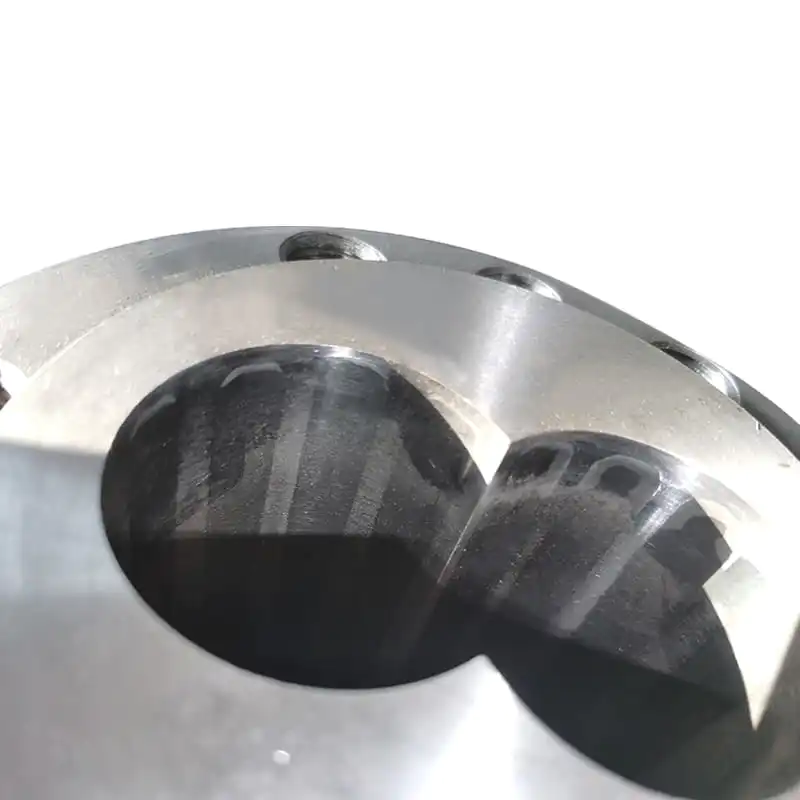
A conical screw barrel is a twin-screw extrusion assembly in which both screws taper from a larger feed diameter at the rear to a smaller outlet diameter at the discharge end. This geometry creates a naturally compressive melt zone, high torque density at the feed throat, and a compact footprint—making conical designs especially popular in PVC pipe, profile, and sheet extrusion lines.
Unlike parallel twin-screw barrels, the conical configuration places the gearbox at a wider center distance, allowing larger, stronger drive shafts without increasing the machine's overall length. The consequence is that every extruder frame size corresponds to a specific conical geometry—and swapping barrels from different size classes is physically impossible without modifying the machine housing.
Key Dimensional Parameters Driven by Extruder Size
1. Inlet Diameter (Di) and Outlet Diameter (Do)
These two diameters define the conical screw barrel's identity. The inlet diameter governs how much material can be fed per revolution, while the outlet diameter controls discharge pressure and flow channel dimensions. Both are fixed by the extruder frame and cannot be altered independently.
2. L/D Ratio and Processing Length
For conical configurations, the effective L/D ratio is measured at the mean diameter. Larger extruders often support longer processing lengths (higher L/D) to improve plasticization and homogenization, which is critical when processing rigid PVC, wood-plastic composites (WPC), or filled compounds.
3. Torque and Drive Power
Larger extruder frames transmit higher torque through the screw shafts. The conical screw barrel must be engineered to withstand the full rated torque without shaft deflection or premature wear on screw flights. Mismatched torque specifications are a leading cause of barrel scoring and spline damage.
4. Heating Zone Count and Thermal Profile
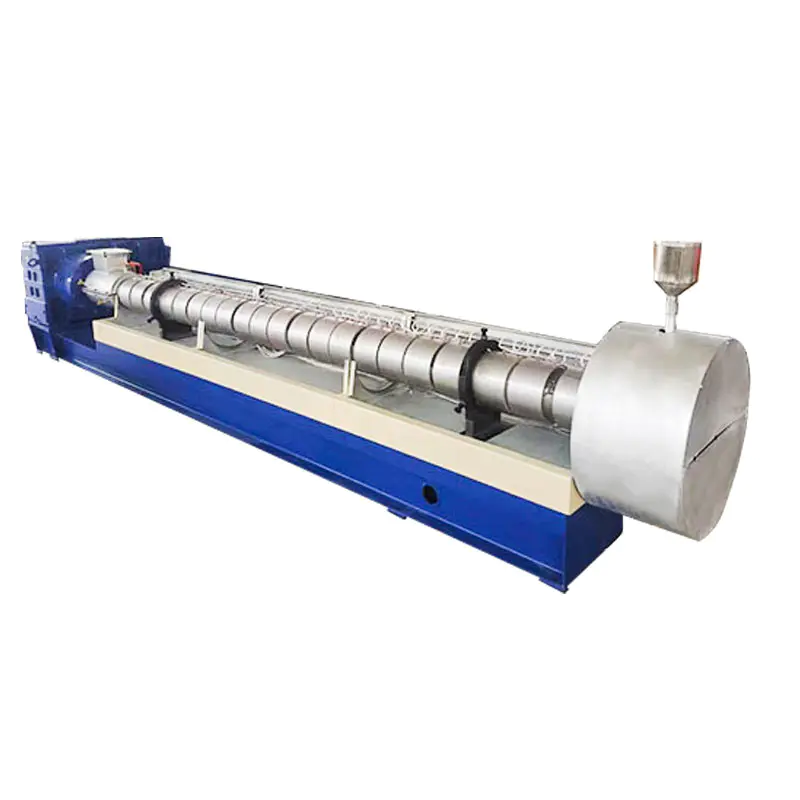
As extruder size increases, the barrel length grows and the number of independently controlled heating zones rises. A compact machine may have 3–4 zones, while a large industrial extruder may require 6–8 zones. Selecting the correct zone configuration ensures precise melt temperature control across the full barrel length.
Conical Screw Barrel Size Comparison by Extruder Class
The table below illustrates how typical extruder size classes map to conical screw barrel specifications:
| Extruder Size Class | Inlet Dia. (Di) | Outlet Dia. (Do) | Typical L/D | Drive Power | Heating Zones | Typical Application |
| Small | 35–45 mm | 22–28 mm | 17–20 | 11–22 kW | 3–4 | Lab / small profiles |
| Medium | 51–65 mm | 32–45 mm | 20–24 | 30–55 kW | 4–5 | PVC pipe, window profiles |
| Large | 80–92 mm | 55–65 mm | 22–26 | 75–132 kW | 5–6 | Large pipe, WPC decking |
| Extra Large | 110–130 mm | 75–95 mm | 24–28 | 160–315 kW | 6–8 | Heavy industrial, sheet |
How Extruder Size Affects Material Compatibility
Extruder size is not just a physical constraint—it determines the shear history, residence time, and pressure profile that the material experiences inside the conical screw barrel. These factors must align with the thermal and rheological properties of the resin being processed.
- Rigid PVC (uPVC): Requires high compression at the feed zone and gentle shear to avoid degradation. Medium-to-large conical barrels with wear-resistant bi-metallic liners are preferred.
- Plasticized PVC (pPVC): Lower melt viscosity allows smaller extruder classes; barrel surface finish becomes critical to prevent adhesion.
- Wood-Plastic Composites (WPC): High filler loading (40–70%) demands large-diameter feed zones and hardened barrel liners. Large or extra-large extruders are standard.
- Foamed Materials: Precise back-pressure control requires a tightly dimensioned outlet diameter; even small deviations in barrel size cause density inconsistencies.
- Recycled Polymers: Variable bulk density demands generous feed throat geometry—a feature that scales directly with extruder size class.
Conical vs. Parallel Twin-Screw Barrel: Size Impact Comparison
Understanding when to choose a conical screw barrel over a parallel design—and how size factors into that decision—is essential for engineers specifying new equipment.
| Criterion | Conical Screw Barrel | Parallel Twin-Screw Barrel |
| Size range | Compact; shorter center distance | Wide range; modular segments |
| Torque at feed | Very high (large Di gearbox shaft) | Moderate; distributed along length |
| Mixing efficiency | Good for homogeneous blends | Superior for reactive/compounding |
| Pressure build-up | Naturally high (tapered geometry) | Requires specific screw element design |
| Best material fit | uPVC, pPVC, WPC, foams | Compounds, masterbatches, engineering resins |
| Size scalability | Fixed geometry per machine frame | Modular—screw elements can be rearranged |
Surface Treatment and Metallurgy: Size-Dependent Decisions
Larger extruders process greater throughput volumes, which means wear accumulates faster inside the conical screw barrel. The correct metallurgical specification scales with both machine size and material abrasiveness:
- Nitrided Steel (38CrMoAlA): Suitable for small extruders processing standard PVC with low filler content. Surface hardness HV 900–1100.
- Bi-metallic Barrel Liner (Fe-based or Ni-based alloy): Recommended for medium and large extruders. The centrifugally cast alloy layer provides hardness HRC 58–65, dramatically extending service life with filled or abrasive compounds.
- Tungsten Carbide Coating: Used in extra-large extruders processing highly abrasive WPC or calcium-filled formulations. Hardness exceeds HV 1400.
- Corrosion-Resistant Alloys: For large machines running halogen-free flame-retardant compounds or hygroscopic materials, corrosion resistance must be specified alongside abrasion resistance.
Output Rate, Throughput, and Size Correlation
One of the most direct relationships between extruder size and conical screw barrel selection is throughput capacity. The volumetric output per revolution scales approximately with the cube of the outlet diameter, meaning small dimensional changes have large throughput consequences.
When specifying a replacement or upgrade barrel, engineers must verify that the selected barrel's specific output (kg/h per RPM) matches the line's production targets. Oversized barrels on small extruders reduce residence time and compromise melt homogeneity; undersized barrels on large extruders create excessive back-pressure and accelerate mechanical fatigue.
Practical Selection Checklist: Matching Extruder Size to Conical Screw Barrel
Use this checklist before placing any conical screw barrel order:
- Confirm machine model and serial number — manufacturers maintain dimension tolerances that differ even between machines of the same nominal size.
- Measure existing Di and Do precisely — use a calibrated bore gauge; worn barrels often have expanded inner diameters that must not be replicated in replacement parts.
- Specify the screw-to-barrel clearance — typical values range from 0.10 mm to 0.25 mm depending on extruder size; tighter clearance improves output but reduces tolerance for thermal expansion.
- Verify heating element compatibility — flange bolt patterns, heater band widths, and thermocouple port positions are size-specific.
- Match metallurgy to material and throughput — reference the material's abrasiveness index and annual tonnage to select the optimal wear-resistant specification.
- Confirm screw and barrel are supplied as a matched pair — independently sourced screws and barrels from different manufacturers often have incompatible flight and liner geometries.
- Review the manufacturer's tolerance documentation — ISO or DIN tolerance grades should be specified in the purchase contract.
How Size Affects Maintenance Intervals and Replacement Cycles
Larger conical screw barrel assemblies carry more mass and operate under higher thermal and mechanical loads. Maintenance intervals should be calibrated accordingly:
| Extruder Size | Recommended Bore Inspection | Typical Barrel Life (uPVC) | Typical Barrel Life (WPC) |
| Small (35–45 mm Di) | Every 3,000 hrs | 8,000–12,000 hrs | 4,000–6,000 hrs |
| Medium (51–65 mm Di) | Every 4,000 hrs | 10,000–15,000 hrs | 5,000–8,000 hrs |
| Large (80–92 mm Di) | Every 5,000 hrs | 12,000–18,000 hrs | 6,000–10,000 hrs |
| Extra Large (110–130 mm Di) | Every 6,000 hrs | 15,000–22,000 hrs | 8,000–12,000 hrs |
Frequently Asked Questions (FAQ)
Conclusion
Extruder size is the single most determinative factor in conical screw barrel selection. From inlet and outlet diameters to torque ratings, heating zone configuration, metallurgical specification, and maintenance scheduling—every parameter flows directly from the machine's size class. There is no universal barrel that fits all extruders, and attempting to adapt an incorrectly sized barrel is a false economy that invariably leads to premature failure and production losses.
By following a structured selection process—confirming machine dimensions, matching metallurgy to material and throughput, and partnering with a supplier who provides complete dimensional documentation—engineers and plant managers can maximize the operational lifespan of their conical screw barrel assets and sustain consistent, high-quality extrusion output across the full production lifecycle.