

 عربى
عربىChoosing the right plastic pelleting machine for PET bottles comes down to matching five core parameters to your specific operation: output capacity, screw configuration, drying and degassing capability, pellet quality requirements, and total cost of ownership. PET (polyethylene terephthalate) is one of the most hygroscopic and thermally sensitive engineering plastics, which means a pelleting line designed for polyethylene or polypropylene will typically produce degraded, discolored, or fragile pellets when fed with PET bottle flake. This guide walks through every critical decision point so you can select a machine that delivers consistent, high-IV (intrinsic viscosity) pellets at the throughput your business requires.
Content
- Why PET Bottle Recycling Demands a Specialized Plastic Pelleting Machine
- What Are the Main Types of Plastic Pelleting Machines for PET?
- How to Evaluate Output Capacity: Matching the Machine to Your Production Volume
- Why the Drying and Degassing System Is the Heart of Any PET Pelleting Line
- How Screw Design Affects Pellet Quality in PET Processing
- Which Pellet Cutting Method Is Best for PET: Strand, Die-Face, or Underwater?
- How to Select the Right Melt Filtration System for PET Bottle Flake
- What Is the Total Cost of Ownership for a PET Plastic Pelleting Machine?
- Why Advanced Process Control Is Essential for Consistent rPET Pellet Quality
- Frequently Asked Questions About Plastic Pelleting Machines for PET Bottles
- Can a general-purpose plastic pelletizer process PET bottle flake without modification?
- What IV level should rPET pellets from a bottle recycling line achieve?
- How often do screw and barrel need replacing on a PET pelleting machine?
- Is single-screw or twin-screw better for PET bottle pelleting?
- What pre-processing steps are required before feeding PET bottle flake into a pelleting machine?
- What certifications should I look for when purchasing a PET plastic pelleting machine?
- Conclusion: A Step-by-Step Framework for Choosing Your PET Pelleting Machine
Why PET Bottle Recycling Demands a Specialized Plastic Pelleting Machine
PET degrades rapidly when processed at the wrong moisture level or temperature, making a general-purpose pelletizer unsuitable for PET bottle flake without significant modification. Unlike polyolefins, PET is highly hygroscopic — it can absorb up to 0.6% moisture by weight simply by sitting in ambient air — and when that moisture remains in the melt, it causes hydrolytic chain scission, dropping the intrinsic viscosity (IV) from a typical bottle-grade 0.80 dL/g to below 0.70 dL/g in a single pass. At IV values below 0.72 dL/g, the resulting pellets are generally unsuitable for food-contact bottle applications and will command significantly lower market prices.
Three properties of PET make machine selection especially critical compared to other recyclable plastics:
- High moisture sensitivity: PET must be dried to below 50 ppm (parts per million) moisture content before entering the extruder. Most commodity plastics tolerate 200–500 ppm without issue.
- Narrow processing window: The melt temperature for PET typically falls between 270°C and 290°C. Even brief excursions above 295°C cause acetaldehyde generation, yellowing, and irreversible IV loss.
- High melt viscosity variance: Recycled PET flake from mixed bottle streams can have widely varying IV and contamination levels, requiring robust screw geometry and consistent throughput control to produce uniform pellets.
What Are the Main Types of Plastic Pelleting Machines for PET?
The three primary pelleting machine configurations used for PET bottle recycling are single-screw extruder pelletizers, twin-screw extruder pelletizers, and solid-state polycondensation (SSP) systems — each with distinct trade-offs in cost, output quality, and IV retention.
| Machine Type | Typical Capacity | IV Retention | Drying Required? | Relative Cost | Best For |
| Single-screw + pre-dryer | 100 – 1,500 kg/h | Good (0.02–0.04 dL/g loss) | Yes (crystallizer + dryer) | Low to Medium | Fiber-grade and sheet-grade rPET |
| Twin-screw with vacuum degassing | 200 – 3,000 kg/h | Very Good (0.01–0.03 dL/g loss) | Optional (vacuum handles moisture) | Medium to High | High-throughput rPET, mixed flake |
| Single-screw + SSP reactor | 500 – 5,000 kg/h | Excellent (IV can increase) | Yes (integral to SSP process) | High | Food-contact bottle-grade rPET |
| Underwater pelletizer (UWP) | 200 – 4,000 kg/h | Good to Very Good | Yes | Medium to High | Uniform spherical pellets, compounding |
Table 1: Comparison of the main plastic pelleting machine configurations for PET bottle recycling by capacity, IV retention, drying requirements, cost, and application.
How to Evaluate Output Capacity: Matching the Machine to Your Production Volume
The single most important starting point when specifying a plastic pelleting machine for PET bottles is your required throughput in kilograms per hour — undersizing by even 20% will create a bottleneck that limits your entire recycling line's profitability.
Use this simple formula to derive the minimum required extruder output:
Required Output (kg/h) = Daily Target (kg) / Operating Hours per Day x Efficiency Factor (typically 0.85)
For example, a recycler targeting 10 metric tons per day running two 8-hour shifts (16 hours) needs: 10,000 / 16 / 0.85 = approximately 735 kg/h minimum nameplate capacity. Selecting a machine rated at 750–800 kg/h would be the correct specification, with a 10–15% headroom buffer built in.
Capacity Classes for PET Pelleting Machines
- Small-scale (50–300 kg/h): Suited to collection-point recyclers, pilot plants, and specialty compounders. Lower capital cost but higher per-kilogram energy consumption.
- Mid-scale (300–1,000 kg/h): The most common configuration for regional recycling facilities processing 2,000–8,000 tons of PET bottles per year.
- Industrial-scale (1,000–5,000 kg/h): Required for national-scale recyclers and large petrochemical operators. Multiple parallel lines are often preferred over a single ultra-high-capacity line for maintenance flexibility.
Why the Drying and Degassing System Is the Heart of Any PET Pelleting Line
Without an effective pre-drying or in-line vacuum degassing system, even the best extruder screw will produce brittle, foamy, or discolored PET pellets that are commercially worthless for bottle-grade applications.
Pre-Drying Route: Crystallizer + Desiccant Dryer
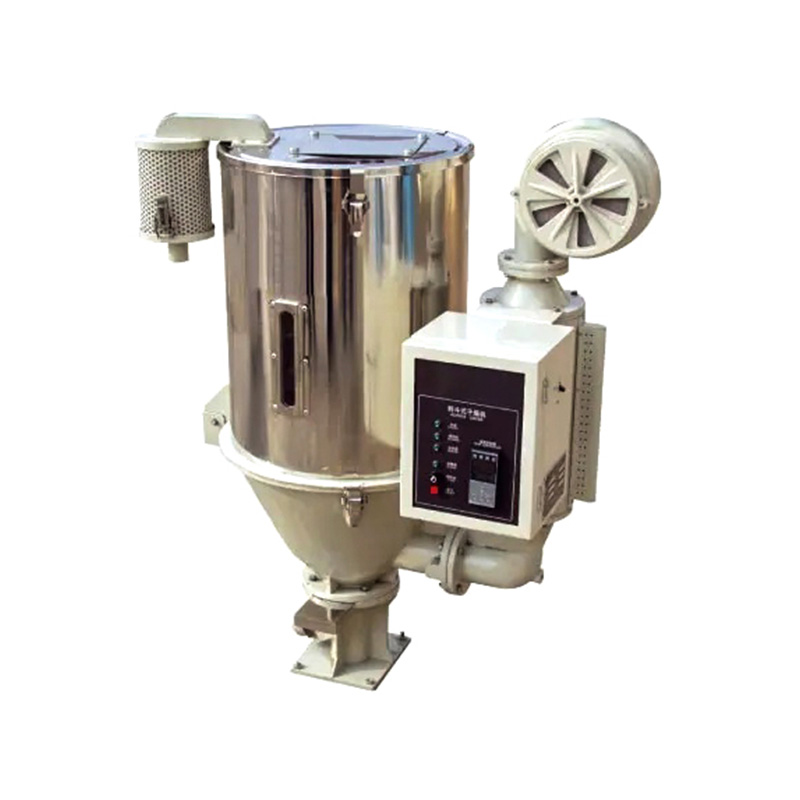
The classical approach pairs a rotary drum crystallizer (operating at 150–170°C) with a desiccant dehumidifying dryer (dew point -40°C or lower). The crystallizer prevents PET flakes from clumping and softening in the dryer by raising crystallinity before the temperature increases. Drying time at 160–170°C for PET flake is typically 4–6 hours to reach the required sub-50 ppm moisture level.
Key drying system specifications to verify with your supplier:
- Dryer dew point: Must reach -40°C or lower; -60°C is preferred for food-grade applications.
- Residence time control: The dryer bin volume should be sized for a minimum of 4 hours at your maximum throughput rate.
- Return air temperature: Should be monitored continuously; a rise in return air moisture indicates flake contamination or a desiccant bed reaching saturation.
In-Line Vacuum Degassing Route
Advanced twin-screw plastic pelleting machines for PET incorporate one or two vacuum degassing zones along the screw barrel. The vacuum (typically 10–50 mbar absolute) removes water vapor and volatile degradation products directly from the melt. This eliminates the need for a large pre-dryer but requires more precise screw design and adds cost. Studies by resin engineers show that a twin-screw line with a 15 mbar vacuum zone can process PET flake at 600 ppm moisture input and still deliver pellets with residual moisture below 40 ppm — a result that would be impossible on a single-screw machine without pre-drying.
How Screw Design Affects Pellet Quality in PET Processing
The extruder screw is the single component that most directly determines IV retention, melt homogeneity, and energy consumption — and a screw designed for generic plastics will consistently underperform when running PET bottle flake.
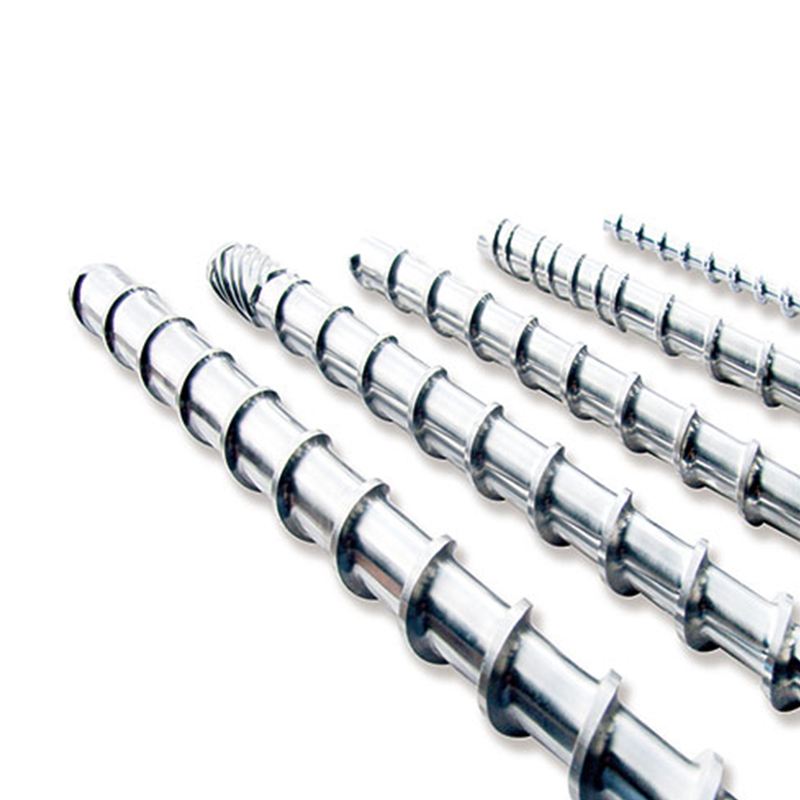
For PET, screw designers typically specify:
- Length-to-diameter (L/D) ratio of 28:1 to 36:1: Longer screws provide more gradual, controlled melting and better homogenization — essential for PET's narrow melt window.
- Barrier and mixing sections: A barrier flight separates unmelted pellets from melt early in the screw, preventing over-shearing. Downstream mixing elements (Maddock or pin-type) ensure a homogeneous, streak-free melt without raising temperature excessively.
- Compression ratio of 2.5:1 to 3.5:1: Too high a compression ratio generates excess frictional heat; too low results in incomplete melting. For PET bottle flake (typically irregular shapes with bulk density 300–450 kg/m3), a 3.0:1 ratio is commonly specified.
- Hardened or bimetallic screw and barrel: PET flake commonly contains trace mineral contamination (sand, glass) that rapidly wears standard tool-steel screws. Bimetallic barrels and hardened-alloy screws extend service life from 2–3 years to 8–12 years under continuous operation.
Which Pellet Cutting Method Is Best for PET: Strand, Die-Face, or Underwater?
For PET bottle recycling, underwater pelletizing (UWP) delivers the most consistent pellet geometry and lowest fines content, while strand pelletizing remains the most cost-effective option for small to medium operations.
| Cutting Method | Pellet Shape | Typical Pellet Size | Fines Generation | Equipment Cost | Suitability for PET |
| Strand pelletizing | Cylindrical | 2–4 mm dia, 3–5 mm long | Low–Medium | Low | Good (small–mid capacity) |
| Die-face (hot-cut) pelletizing | Lenticular / disc | 2–5 mm dia | Medium | Medium | Fair (risk of angel hair) |
| Underwater pelletizing | Spherical | 2–4 mm dia | Very Low | High | Excellent (all capacities) |
| Water-ring pelletizing | Irregular disc | 2–5 mm dia | Low–Medium | Medium | Good (mid capacity) |
Table 2: Comparison of pellet cutting methods for PET pelleting machines by pellet shape, size, fines generation, equipment cost, and suitability for PET bottle recycling.
One specific consideration for PET: because the material is semi-crystalline and cools rapidly, strand pelletizing lines must be carefully designed to prevent strand breakage. Water bath temperature should be controlled at 40–60°C (not ambient cold water) to allow gradual and uniform cooling. Abrupt quenching increases the brittleness of strands and leads to higher fines and irregular pellet lengths.
How to Select the Right Melt Filtration System for PET Bottle Flake
Continuous screen changers are the only practical filtration solution for high-throughput PET pelleting lines, because stopping production to change screens on a manual unit results in significant thermal degradation every time the melt is interrupted.
PET bottle flake from post-consumer streams typically contains contaminants including polyolefin cap fragments, paper label residue, adhesive, aluminum foil, and mineral particulates. The melt filtration screen must remove these before pelletization. Key specifications:
- Screen mesh fineness: 100–150 micron screens are standard for general fiber-grade rPET. 60–80 micron screens are required for film-grade and bottle-grade applications. Finer screens increase pressure drop and require higher motor power.
- Continuous self-cleaning (back-flush) screen changers: These automatically purge contamination from the screen without interrupting melt flow — critical for maintaining IV and avoiding degradation from prolonged residence time during screen changes.
- Screen changer design pressure rating: PET melt can generate pressures of 200–400 bar at the die; the filtration system must be rated accordingly, typically 350–500 bar.
What Is the Total Cost of Ownership for a PET Plastic Pelleting Machine?
The purchase price of a plastic pelleting machine for PET bottles typically represents only 35–50% of the total 10-year cost of ownership — energy, wear parts, maintenance, and downtime account for the rest.
| Cost Category | Small Line (200 kg/h) | Mid Line (800 kg/h) | Large Line (2,000 kg/h) |
| Capital equipment | USD 80,000 – 150,000 | USD 350,000 – 700,000 | USD 1.2M – 2.5M |
| Energy (electricity) per ton | USD 18 – 30 | USD 12 – 20 | USD 9 – 15 |
| Annual wear parts | USD 4,000 – 8,000 | USD 15,000 – 35,000 | USD 50,000 – 120,000 |
| Estimated payback period | 3 – 5 years | 2.5 – 4 years | 2 – 3.5 years |
Table 3: Indicative total cost of ownership breakdown for PET plastic pelleting machine lines at three capacity levels (2026 estimates, USD basis).
The per-ton energy efficiency advantage of larger lines is significant: a well-optimized 2,000 kg/h PET pelleting line typically consumes 220–280 kWh per metric ton including drying, extrusion, and pellet handling, compared to 350–450 kWh/ton for a 200 kg/h small-scale line. At an electricity cost of USD 0.10/kWh and 6,000 operating hours per year, that difference amounts to over USD 90,000 per year in energy savings on a 2,000 kg/h line alone.
Why Advanced Process Control Is Essential for Consistent rPET Pellet Quality
A modern PET pelleting line should include a PLC-based control system with closed-loop temperature and pressure feedback, online IV monitoring, and an alarm management system — without these, maintaining pellet quality across shift changes and feedstock variations is extremely difficult.
Recommended control features to request when specifying a plastic pelleting machine for PET bottles:
- Melt pressure feedback to screw speed: Automatically adjusts throughput to maintain stable die pressure, preventing surging and uneven pellet cutting.
- Barrel temperature zone independent control: Each heating and cooling zone (typically 8–12 zones on a 30:1 L/D screw) should be independently controlled to within ±1°C.
- Online IV or viscosity monitoring: Inline melt viscometers or offline IV sampling integrated into the process control system alert operators when IV falls below specification before a full batch is produced off-spec.
- Dryer dew point and moisture alarms: Automatic shutdown or feed interruption if inlet moisture exceeds a preset threshold prevents a single drying failure from producing an entire run of degraded pellets.
- Data logging and OEE (Overall Equipment Effectiveness) reporting: Industry 4.0-ready systems log throughput, downtime causes, energy consumption, and quality parameters for process optimization and traceability documentation required by food-contact regulations.
Frequently Asked Questions About Plastic Pelleting Machines for PET Bottles
Can a general-purpose plastic pelletizer process PET bottle flake without modification?
In most cases, no. A general-purpose single-screw extruder pelletizer designed for polyolefins lacks the pre-drying system, appropriate screw design (L/D ratio, compression ratio), and melt temperature precision required for PET. Running PET in such a machine typically produces discolored, brittle pellets with severely reduced IV. At minimum, a proper PET-capable drying system and a PET-specific screw must be fitted before the machine can deliver acceptable rPET pellet quality.
What IV level should rPET pellets from a bottle recycling line achieve?
For fiber-grade rPET (used in polyester staple fiber and filament yarn), an IV of 0.62–0.72 dL/g is generally acceptable. For sheet and thermoforming applications, 0.72–0.80 dL/g is preferred. For food-contact bottle-to-bottle applications compliant with FDA and EFSA regulations, the rPET pellets must reach 0.78–0.85 dL/g, which often requires a solid-state polycondensation (SSP) step after extrusion pelletizing to restore or increase the IV.
How often do screw and barrel need replacing on a PET pelleting machine?
With a standard tool-steel screw and barrel processing clean, well-washed PET bottle flake, wear life is typically 3,000–5,000 operating hours (1.5–2.5 years at two-shift operation). Bimetallic barrels and hardened-alloy screws extend this to 15,000–25,000 hours under the same conditions. Given that screw and barrel replacement costs USD 8,000–40,000 depending on machine size, upgrading to bimetallic components at initial purchase nearly always delivers a positive return on investment within 2–3 years.
Is single-screw or twin-screw better for PET bottle pelleting?
Both configurations work well when properly specified. Single-screw machines with pre-drying are lower in capital cost and easier to operate and maintain — making them the preferred choice for most mid-scale recyclers. Twin-screw machines with vacuum degassing offer superior mixing capability, better handling of variable or wet input material, and are preferred when the feedstock quality varies significantly or when compounding additives (stabilizers, colorants, chain extenders) into the PET melt. The twin-screw premium in capital cost is typically 30–60% compared to an equivalent single-screw line.
What pre-processing steps are required before feeding PET bottle flake into a pelleting machine?
A complete PET bottle recycling line upstream of the pelleting machine typically includes: bale breaking and sorting, label removal and air classification, bottle crushing and granulation, hot-wash (caustic wash at 80–85°C) to remove adhesives and contaminants, cold rinse, friction washing, float-sink separation (to remove polyolefin caps), centrifugal drying (to below 1% surface moisture), and finally the thermal drying stage immediately before the extruder. Skipping or under-specifying any of these stages introduces contaminants that degrade pellet quality and accelerate wear on the pelleting machine's screw, barrel, and filtration system.
What certifications should I look for when purchasing a PET plastic pelleting machine?
For machinery sold into the European market, CE marking under the Machinery Directive (2006/42/EC) is mandatory. For food-contact rPET applications, the machine should be compatible with producing pellets traceable under FDA 21 CFR and EU Regulation 10/2011. The control system should ideally comply with IEC 61511 for functional safety. Additionally, energy efficiency certification (e.g., IE3 motor classification) is increasingly required by corporate sustainability policies and public procurement frameworks in 2025–2026.
Conclusion: A Step-by-Step Framework for Choosing Your PET Pelleting Machine
The right plastic pelleting machine for PET bottles is the one that matches your throughput, delivers the target pellet IV consistently, fits within your total cost of ownership budget, and integrates reliably with your upstream washing and downstream SSP or packaging systems.
Follow this practical selection sequence:
- Define your annual tonnage target and convert it to a required hourly throughput with an 85% availability factor.
- Specify the required output pellet IV based on your end market: fiber-grade (0.62–0.72), sheet-grade (0.72–0.80), or bottle-grade (0.78–0.85 with SSP).
- Evaluate your feedstock quality — consistent, well-washed clean flake favors single-screw with pre-dryer; variable or wet feedstock favors twin-screw with vacuum degassing.
- Choose the pellet cutting method appropriate to your pellet quality needs and budget: strand pelletizing for economy, underwater pelletizing for maximum consistency.
- Verify screw and barrel materials — insist on bimetallic barrel and hardened-alloy screw for any continuous production environment.
- Calculate 10-year total cost of ownership including energy, wear parts, and downtime — not just the capital equipment price.
- Confirm after-sales support — spare parts availability, commissioning assistance, and operator training are as important as the machine specification itself for long-term operational success.
The global rPET market is projected to grow at over 8% per year through 2030, driven by brand-owner sustainability commitments and expanding extended-producer-responsibility (EPR) legislation. Investing in a well-specified plastic pelleting machine for PET bottles today positions recyclers to capture premium pricing for high-IV food-grade rPET pellets — the fastest-growing and highest-margin segment of the recycled resin market.